AI-Powered Training for Health, Care & Social Work
Build confidence for
difficult relativesdistressed patients
Realistic voice simulations that let NHS staff, care workers, and social workers rehearse difficult conversations with patients, relatives, and staff, using AI speech models that adapt to every word you say — on any device with a browser and microphone.
Mobile-First, Not Headset-Dependent
Immersive training without the hardware overhead
Extended reality headsets are expensive to procure, difficult to deploy at scale, and costly to maintain. Every headset needs charging, cleaning, software updates, and technical support — and your training capacity is limited by how many units you own as well as the time and costs of developing immersive content.
prolog runs on the devices your staff already carry. A mobile phone, tablet, or laptop with a browser and microphone is all it takes. This makes it significantly cheaper to produce, deploy, and maintain — while delivering a more meaningful level of engagement, because trainees practise with their own voice in natural spoken conversation rather than navigating a virtual environment with controllers.
| prolog | XR Headsets | |
|---|---|---|
| Hardware required | Any device with a browser | Dedicated headset per trainee |
| Hardware cost | None | Significant per-unit investment |
| Content creation | Minimal — educators configure scenarios in minutes | Expensive 3D environments, voice actors, scripting |
| Deployment | Share a link | Provision, configure, distribute |
| Ongoing maintenance | None | Charging, cleaning, repairs, updates |
| Scalability | Unlimited — scales with your cohort | Limited by inventory |
| Engagement model | Natural voice conversation | Fixed multiple choice options |
Safe, realistic practice for high-stakes conversations
Handling difficult conversations and building skills like de-escalation takes practice, not just theory. prolog gives healthcare staff, care workers, and social workers a safe space to practise with AI-powered patients, relatives, and colleagues who respond dynamically to tone, technique, and timing — without risk to real people.
Zero-Risk Environment
Make mistakes, try new approaches, and build confidence without consequences for patients, relatives, or colleagues.
Real Conversation, Not Scripts
AI characters respond to what you actually say. Every session unfolds differently based on your choices.
Practise and Repeat
Replay sessions from any point, fork the conversation to try a different technique, and track improvement over time.
System Architecture
Complete training system from authoring to review
Educators author scenarios with domain knowledge, safety constraints, and scoring rubrics. Trainees interact with the live runtime core where the AI counterpart, behavioural model, and assessment engine work together during every conversation. Review and feedback outputs complete the learning cycle.
Features
Everything you need for effective training
Scenario Builder
Educators create custom scenarios with 15 personality dials, configurable voice settings, bias categories, escalation rules, and clinical milestones — or start from archetype presets.
Real-Time Voice Simulation
Speak naturally with AI patients, relatives, and staff through your microphone. Voice tone, pacing, and emotional intensity all shift dynamically as the conversation evolves.
Evidence-Based Scoring
Performance is measured across four dimensions — composure, de-escalation effectiveness, clinical task maintenance, and support seeking — each backed by turn-level evidence.
Detailed Post-Session Review
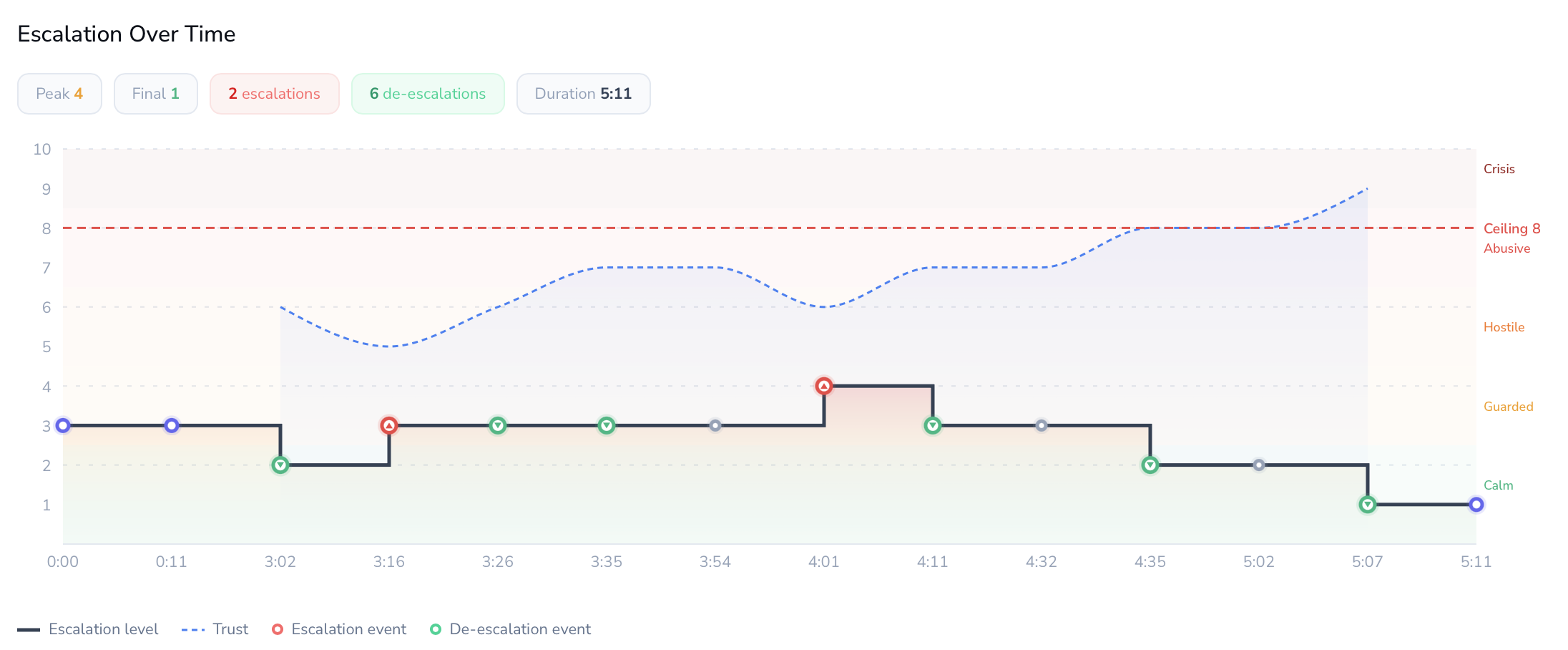
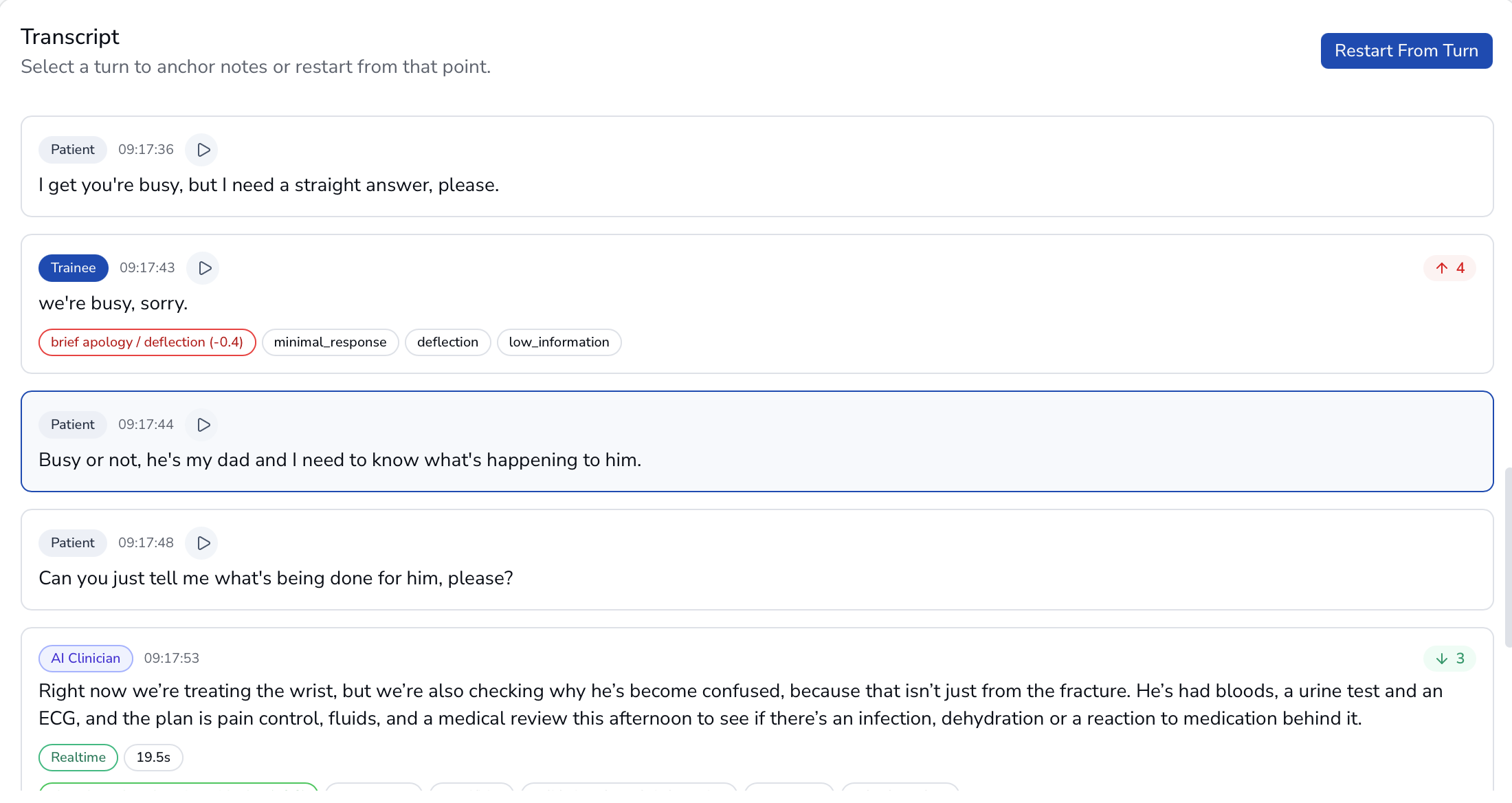
Review full transcripts with audio playback, an escalation timeline, key moment highlights, and AI-generated suggestions for what to try next time.
Governance Controls
Organisation admins set escalation ceilings, session time limits, content policies, and consent gates to keep training safe and appropriate.
Dynamic Escalation Engine
A 10-level state machine tracks escalation, trust, anger, and frustration. Your communication technique directly influences whether the situation improves or worsens.
Session Outputs
See exactly how the conversation unfolded
Every session produces a rich set of outputs: an escalation timeline, a full transcript with per-turn audio playback, and the option to fork and restart from any point.
Scenario Configuration
Fine-tune every aspect of the AI character
Educators shape the patient or relative's personality across emotional, behavioural, cognitive, and vocal dimensions. Toggle specific bias categories and control their intensity to create precisely the training challenge needed.
Emotional Baseline
Behavioural Style
Voice Settings
Bias Categories
4 active. Bias intensity slider controls the strength.
How It Works
From scenario to skill in five steps
- 1
Choose a scenario
Browse published scenarios on your dashboard, each designed around a specific clinical setting and patient or relative personality. Educators can also create custom scenarios from scratch.
- 2
Read the briefing
Review your role, the situation, learning objectives, and any content warnings before the simulation begins.
- 3
Speak with the AI patient or relative
A live voice conversation begins. The character reacts in real time to your words, tone, and approach. An escalation meter shows how the situation is developing.
- 4
Apply your techniques
Use de-escalation strategies to bring the situation under control. If needed, call in the AI clinician for support — knowing when to ask for help is part of the assessment.
- 5
Review your performance
Get scored across four dimensions with turn-level evidence. Replay the full audio recording, study the escalation timeline, and fork from any turn to try a different approach.
Built For Health, Care & Social Work
Designed for the people who need it most
Nurses & Midwives
Practise managing distressed relatives and aggressive patients on wards.
Doctors & Registrars
Build confidence delivering difficult news and handling confrontation.
Care Workers
Rehearse responses to challenging behaviour in residential and domiciliary settings.
Social Workers
Prepare for high-conflict home visits, safeguarding conversations, and family mediation.
GP Receptionists
Rehearse front-desk encounters with frustrated or demanding patients and relatives.
Educators & Trainers
Create targeted scenarios, observe sessions, and provide turn-level feedback and notes.
Auditable & Transparent
Every session is fully recorded and reviewable
Because the entire conversation is audio-recorded and transcribed, every session is auditable. Trainees, educators, and administrators can review exactly what was said, how the AI responded, and how scores were assigned. If a score feels inaccurate, the evidence trail is there to support a dispute.
A training tool, not a replacement for formal assessment
AI scoring is probabilistic by nature. prolog is designed to help trainees build adaptable muscle memory for difficult conversations — preparation for an OSCE or similar structured assessment, not a substitute for one. Think of it as a practice ground that accelerates readiness, with enough rigour to be useful and enough transparency to be trusted.
Outcomes
What your team gains
Confidence handling aggression, distress, and discriminatory behaviour from patients, relatives, and colleagues
Adaptable muscle memory for difficult conversations, built through repeated practice
Objective, evidence-based feedback on communication technique across four dimensions
Ability to replay audio, fork sessions, and test alternative approaches from any point
Educator oversight with session-level and turn-level notes
Measurable progress across composure, de-escalation, and support seeking
Reduced risk of workplace incidents through better-prepared staff
Significantly lower cost than XR-based training, with no hardware to procure or maintain
Roadmap
Future updates
The current simulation is designed around microaggressions, but in reality almost any type of conversational scenario could be implemented. Here is what is on the horizon.
Additional Scenario Domains
Update the scenario modelling and scoring method to support any conversation type — extending prolog beyond de-escalation into broader communication skills training.
Trainee Video & Body Language Feedback
Capture video or snapshots of the trainee during the session and provide AI-generated feedback on facial expression and body language while they are listening and speaking.
Staff-to-Staff Scenarios
Extend the AI counterpart so that it can simulate microaggressions from other staff members rather than only patients and relatives, reflecting the full range of workplace interactions.
Educator-Editable AI Prompts & Knowledge Bases
Enhance the settings page so educators can directly edit the AI prompts used for the escalation engine and scoring engine, and upload associated knowledge bases for specific domain scenarios.
Higher-Quality Transcription
Use a higher-quality transcription model to allay concerns over potential divergence between what the trainee said and what is presented on screen — even though the AI already handles such divergence gracefully.
Anonymised Cohort Scoreboard
Create an anonymised scoreboard so trainees know where they are scoring relative to their cohort, providing motivation and context for improvement.
AI-Generated Visual Immersion
Present small AI-generated video clips or images as a way of immersing the trainee in the scenario — adding visual context to the voice-first experience.
Granular Microaggression Controls
Give educators fine-grained control over the specific types of microaggression exhibited by the AI patient, relative, or staff member during a scenario.
Ready to start training?
prolog is provided free of charge as an in-house training tool. Create an account in seconds and start practising.